
Answer Engine Optimization is the term that’s been building momentum in marketing circles throughout 2026. The premise is straightforward: as more searchers get answers directly from AI tools like ChatGPT, Perplexity, and Google’s AI Overviews instead of clicking through to websites, traditional SEO metrics tell an incomplete story. You might be ranking on page one of Google and still be losing visibility to AI-generated answers that never send traffic anywhere.
HubSpot launched AEO (Answer Engine Optimization) as a feature in Marketing Hub during Fall 2026, currently in public beta. It’s the first CRM platform to build this measurement capability natively, which is notable. But “notable” and “essential” are different things, and this post is about helping you decide which one AEO is for your business specifically.
What HubSpot AEO Actually Does
HubSpot AEO measures your brand’s visibility in AI-generated responses. Specifically, it tracks whether and how often your brand, products, or content are mentioned or cited when AI tools respond to queries relevant to your business.
The tool provides what HubSpot calls an “AI Search Sensor” — a monitoring system that queries AI search tools with prompts relevant to your business and tracks whether your brand appears in the responses.
The practical output is a visibility score: a measure of how present your brand is in AI answers for your relevant queries, compared against competitors you define. Over time, you can see whether this score is improving or declining, and correlate it against your content and PR activity.
This is new data. No standard SEO tool has been tracking AI answer visibility because the concept barely existed two years ago. HubSpot being first to put this in a CRM is a legitimate product development achievement.
Where to Find It and What It Costs
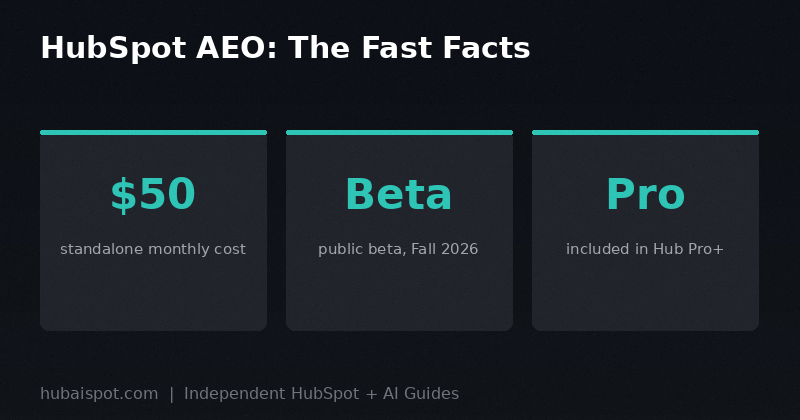
AEO is in public beta as part of the Fall 2026 release. You can find it in Marketing Hub under the SEO or AI section depending on your portal configuration.
Pricing: AEO is available as part of Marketing Hub Professional and Enterprise. It’s also available as a standalone add-on at $50 per month for users on other tiers or who want it without a full Marketing Hub upgrade.
For Marketing Hub Professional users, it’s included — you don’t pay extra for the tool itself. For Starter users or those evaluating whether it’s worth the standalone cost, the $50/month question is whether you’d act on the data it provides.
What the AEO Score Actually Tells You
Your AEO visibility score measures how often your brand appears in AI responses for a defined set of queries. HubSpot sets up the query set based on your company profile and the keywords and topics you’re tracking.
A high score means AI tools frequently mention your brand when answering questions in your category. A low score means they rarely do. A declining score means you’re losing ground in AI answer visibility.
What the score doesn’t tell you directly is what’s causing a high or low score, or what specific content changes would move it. This is the tool’s current limitation. It’s a measurement instrument, not an optimization playbook. HubSpot provides guidance on factors that influence AI answer inclusion, but the specific attribution is still fuzzy.
Why AI Answer Visibility Matters (and When It Doesn’t)
The case for caring about AI answer visibility is intuitive for certain buyer journeys. When someone is early in a research process and asks ChatGPT “what’s the best tool for managing customer relationships?” the AI’s answer shapes their consideration set before they ever run a Google search. If your brand isn’t mentioned, you don’t exist to that buyer at that moment.
For B2B SaaS categories with long sales cycles and high-consideration decisions, this early-research visibility can be meaningful. The same buyer who got introduced to your brand through an AI answer might become the deal that closes six months later.
However, there are important caveats:
The correlation between AI mentions and business outcomes is unproven at scale. We know AI tools are being used for research. We don’t yet have clear data on how much AI answer inclusion influences purchase decisions compared to other touchpoints. HubSpot’s AEO tool measures visibility; it can’t yet measure whether that visibility drives revenue.
Search behavior varies dramatically by audience. Enterprise buyers researching complex solutions often use more traditional research methods — analyst reports, peer referrals, vendor websites. Consumer-influenced B2B categories where younger buyers conduct research like consumers are more likely to be using AI search tools heavily.
AEO strategies and SEO strategies largely overlap. The content that gets cited in AI answers tends to be high-quality, authoritative, well-structured content from credible sources. Which is also exactly what ranks well in traditional search. Building content with depth, accuracy, and specificity is the right strategy regardless of whether you’re optimizing for Google or AI answer engines.
What Influences AI Answer Inclusion
Based on what’s known about how AI tools select content to cite and reference, the factors that influence AI answer visibility include:
Domain authority and brand recognition. AI tools trained on internet data tend to cite sources they’ve seen cited frequently. Brands with strong existing web presence and backlink profiles have an advantage.
Content quality and specificity. AI tools favor content that answers questions directly and with specificity. Comprehensive guides, detailed comparisons, and content that addresses specific use cases perform better than generic marketing copy.
Third-party citations and reviews. When industry publications, review sites (G2, Capterra), and credible blogs mention your brand positively and specifically, AI tools trained on that data are more likely to include your brand in responses.
Structured content formats. FAQ sections, clearly defined answers to specific questions, and content organized around how people ask questions (rather than how companies want to talk about themselves) tend to be more citation-friendly.
Freshness and accuracy. Outdated information or content that conflicts with current product reality can lead AI tools to exclude or deprioritize it.
None of these factors are exclusive to “AEO.” They’re all elements of solid content strategy that improves both traditional SEO and AI answer visibility. The strategic implication is that if you’re doing content well, you’re likely already building AI answer visibility as a byproduct.
The One Use Case Where AEO Is Genuinely Valuable
Competitive intelligence. Specifically, knowing which competitors are appearing in AI answers for your category’s queries, and whether that’s changing over time.
If you’re in a market with 3 or 4 strong competitors and you want to understand how AI tools are representing your category, the AEO scoring against named competitors is useful data. If a competitor’s brand is consistently appearing in AI answers and yours isn’t, that’s a signal worth investigating — which of their content characteristics are earning citations, and what you could do to close the gap.
This use case is more strategic than operational. It’s relevant for marketing leaders thinking about brand positioning at a medium-to-long time horizon, not for campaign managers who need to make decisions this week.
How This Connects to the Zero-Click Problem
If you’ve been watching the search console data for your site and wondering why your impression count keeps growing while clicks stay flat, AI Overviews and answer engine responses are likely part of the explanation.
We covered this in the context of hubaispot.com’s own data: comparison keywords ranking at position 3 to 6, with strong impression volume but zero clicks. Some of that gap is position-related. Some of it is AI Overviews intercepting traffic that used to click through.
HubSpot AEO doesn’t solve the zero-click problem directly — your brand appearing in an AI answer doesn’t mean a user clicks through to your site. But measuring your AI visibility gives you a more complete picture of whether your brand is reaching buyers during their research phase, even when those buyers never show up as clicks in your search console.
That measurement is worth having. Whether it justifies $50/month as a standalone tool depends on how important brand visibility during the AI research phase is to your specific buyer journey.
Should You Enable It Now or Wait?
If you’re on Marketing Hub Professional or Enterprise, enable it. It’s included, the data is interesting, and it’s better to have a visibility baseline now than to wish you’d started tracking six months from now.
If you’re on Starter and evaluating the $50/month standalone, wait unless you have a specific competitive intelligence question you need answered. The core content strategies that improve AI answer visibility don’t require AEO to implement. You can start improving your content depth, FAQ coverage, and third-party citation profile without measuring it through the AEO dashboard.
When the tool moves out of public beta and HubSpot publishes more data on the correlation between AEO scores and business outcomes, that’ll be a better decision point for whether the standalone investment makes sense.
How AEO Fits Alongside Your Existing SEO Work
AEO doesn’t replace anything in your existing SEO workflow. It adds a measurement layer for a channel (AI answer engines) that wasn’t previously measurable within HubSpot.
The strategies that improve AEO visibility — comprehensive content, authoritative sources, structured Q&A formats, strong third-party presence — are the same strategies that improve traditional SEO. If you’re doing one well, you’re building the foundations for the other.
The addition of AEO to HubSpot is most useful as a reporting and competitive monitoring tool. For teams that already have strong content production and traditional SEO practices, it provides a richer picture of brand visibility. For teams still building those foundations, fixing the fundamentals will do more for your AI answer visibility than the AEO dashboard on its own.
For how traditional SEO optimization fits into the HubSpot AI stack, the 10 HubSpot automation workflows post covers the intersection of AI tooling and marketing execution. For a deeper look at how HubSpot’s AI compares to standalone content tools, our Breeze AI vs Copy.ai comparison covers the content generation side of the equation.
HubAISpot covers independent, practical guides on HubSpot and AI for marketers and sales teams. No vendor relationships. No paid placements.
Leave a Reply