The debate has been running in every agency Slack group for three years now.
GoHighLevel comes up and someone says it’s the obvious choice — white-label everything, own your client stack, pay a fraction of HubSpot’s price. Then someone else says they tried it, hated the UI, and came back to HubSpot six months later with their tail between their legs.
Both sides are right. The problem is they’re usually talking about different agencies.
This comparison is for agency owners who are actually evaluating both tools — not looking for validation of a decision they’ve already made. I’ll give you the honest breakdown: where each platform wins, who each one is built for, and the specific inflection point where it makes sense to switch or stay.
What Each Platform Actually Is
Before comparing features, it’s worth being precise about what these tools are — because they’re solving slightly different problems.
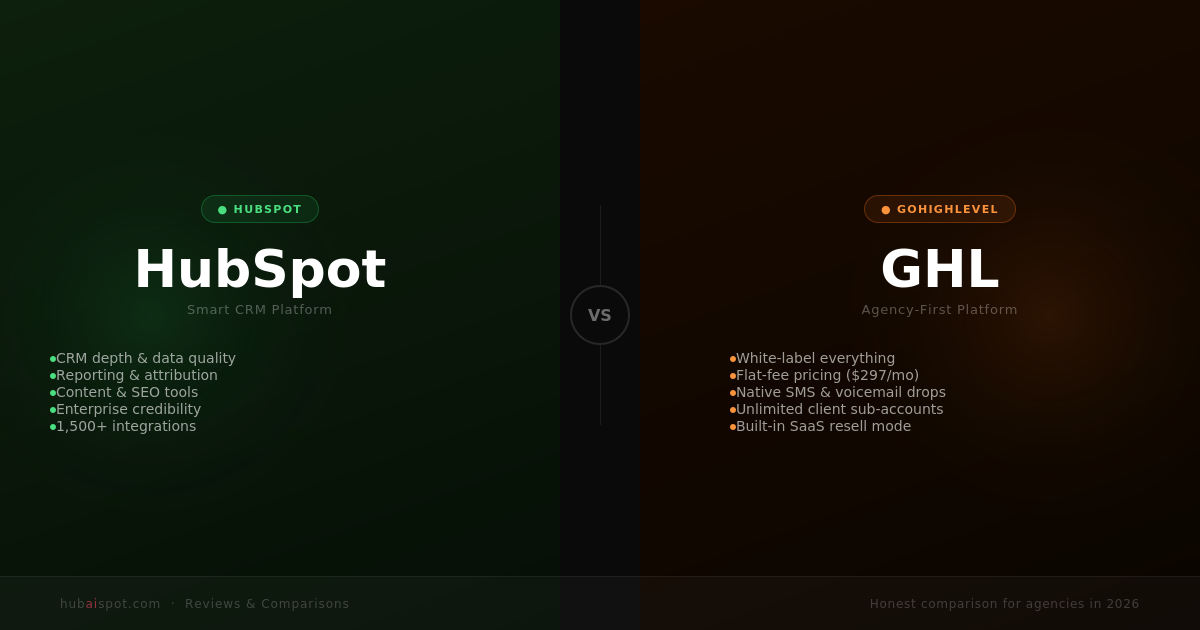
HubSpot is a full customer platform built around a Smart CRM. Its strength is the depth of its native tools — Marketing Hub, Sales Hub, Service Hub, Content Hub, and Operations Hub all share the same database. It was designed for companies managing complex inbound funnels and long sales cycles, with serious reporting requirements.
GoHighLevel (GHL) is an agency-first platform built specifically for the needs of marketing agencies that serve local or SMB clients. Its core value proposition is consolidation — replace your funnel builder, email platform, SMS tool, booking system, review management, and CRM with a single white-labeled platform you can resell to clients.
That distinction matters. HubSpot is optimized for your own growth. GoHighLevel is optimized for managing and billing your clients.
Pricing: Where GoHighLevel Pulls Ahead
This is the most common reason agencies look at GoHighLevel, and the numbers are genuinely compelling at the right scale.
GoHighLevel pricing:
- Starter: $97/month — unlimited contacts, core CRM features, funnels, email, SMS
- Unlimited: $297/month — unlimited sub-accounts (client accounts), white-labeling, API access
- SaaS Mode: $497/month — resell GoHighLevel as your own branded product
HubSpot pricing (for an agency running client work):
- Marketing Hub Starter: $20/month per seat (limited features)
- Marketing Hub Professional: $890/month (3 seats included)
- Sales Hub Professional: $500/month (5 seats)
- Enterprise tiers: $3,600+/month
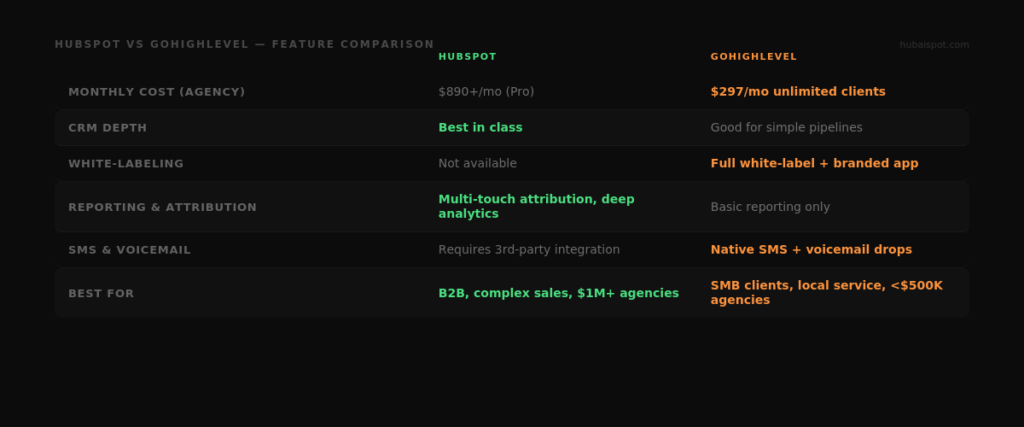
The math is stark. An agency managing 10 clients on GoHighLevel’s Unlimited plan pays $297/month total. The same agency trying to run client accounts through HubSpot Professional is looking at costs that compound per seat and per account.
The catch: HubSpot’s pricing is per-portal. If you’re running each client in their own HubSpot instance (which is the right way to do it), the costs multiply. GoHighLevel’s sub-account model was designed to solve exactly this — one flat fee, unlimited client accounts.
For agencies under roughly $500K in annual revenue, GoHighLevel’s pricing case is genuinely hard to argue with.
Features: Where HubSpot Pulls Ahead
CRM Depth and Data Quality
HubSpot’s CRM is more sophisticated than GoHighLevel’s by a meaningful margin. Custom objects, association labels, multi-touch attribution, predictive lead scoring, and Breeze AI intelligence are all native to HubSpot and either absent or underdeveloped in GoHighLevel.
If your clients are running complex B2B sales cycles — multiple stakeholders, long deal timelines, territory management — HubSpot handles this with precision. GoHighLevel’s CRM works well for simple pipelines but struggles with complexity.
Marketing Automation
Both platforms have visual workflow builders. GoHighLevel’s is more intuitive for simple sequences. HubSpot’s is more powerful for complex branching logic, multi-object enrollment criteria, and AI-assisted optimization.
GoHighLevel also adds SMS and voicemail drops natively — channels HubSpot requires third-party integrations to support. For local service business clients (HVAC, dentists, real estate), SMS automation is essential and GoHighLevel does it better.
Reporting and Analytics
HubSpot wins this category clearly. Its reporting library, custom dashboards, multi-touch revenue attribution, and funnel analytics are among the best in the industry. GoHighLevel’s reporting covers the basics but lacks depth for clients who want serious analytics.
If you’re running paid media for clients and need to prove ROI with attribution data that goes beyond last-click, HubSpot’s reporting is a genuine competitive advantage in client retention conversations.
White-Labeling and Client Management
GoHighLevel wins this category entirely. The ability to white-label the platform, create a branded mobile app for clients, and manage unlimited sub-accounts from a single agency dashboard is GoHighLevel’s core differentiator. HubSpot has no equivalent.
For agencies whose value proposition includes a “proprietary platform,” GoHighLevel makes that story possible at a price that isn’t embarrassing.
Content and SEO Tools
HubSpot’s Content Hub is a full CMS with SEO recommendations, A/B testing, and AI blog writing built in. GoHighLevel has a basic website and funnel builder that works for landing pages but isn’t a real CMS.
If content marketing is part of your agency’s service offering, this gap matters.
Integrations and Ecosystem
HubSpot has over 1,500 native integrations. GoHighLevel has fewer but covers the essentials — Stripe, Zapier, Twilio, and a growing marketplace. For most agency use cases, GoHighLevel’s integration depth is sufficient. For enterprise clients with complex tech stacks, it often isn’t.
The Real Reason Agencies Switch to GoHighLevel
It’s rarely the features. It’s the business model.
GoHighLevel’s SaaS mode lets agencies create a recurring revenue stream by reselling a white-labeled version of the platform to clients. An agency charging $297/month to 20 clients for “their” CRM platform is generating $5,940/month in SaaS revenue on a $497/month tool cost.
That’s a fundamentally different business model than agency retainers — and it’s what attracts serious operators. If building a SaaS revenue stream is part of your agency growth strategy, GoHighLevel enables it. HubSpot doesn’t.
The Real Reason Agencies Switch Back to HubSpot
GoHighLevel’s UI is genuinely difficult. The platform has grown fast and the product quality shows the cracks of rapid development. Support is slower than HubSpot’s. The reporting gaps become painful when clients start asking hard questions about attribution.
And most significantly: mid-market and enterprise clients won’t use GoHighLevel. If your agency aspires to serve clients above a certain size — funded startups, mid-size B2Bs, companies with in-house marketing teams — those clients either already have HubSpot or expect it. Showing up with a GoHighLevel sub-account puts you at a disadvantage before the conversation starts.
Who Should Use Each Platform
GoHighLevel is the right choice if:
- You serve local service businesses or SMB clients
- You want to white-label a platform and create SaaS revenue
- You’re running high-volume, simple funnels with SMS and appointment booking
- Budget is a real constraint and you manage multiple clients
- You’re building a systems-based agency where the platform is part of the product
HubSpot is the right choice if:
- You serve B2B clients with complex sales cycles
- Reporting and attribution are central to your client value proposition
- You work with clients who already have HubSpot or have tech stack requirements
- Content marketing is a core service offering
- You’re building toward serving mid-market or enterprise clients
The honest answer for most agencies: if you’re under $500K annual revenue and serving SMB clients, start with GoHighLevel. If you’re pushing toward $1M+ and selling to B2B clients who care about data, HubSpot becomes the defensible choice.
Can You Use Both?
Some agencies do. They run GoHighLevel for local service clients (where the economics and simplicity make sense) and HubSpot for B2B or higher-value accounts. It’s not elegant, but it’s pragmatic.
The overhead of maintaining both platforms is real — two sets of workflows, two sets of training, two sets of integrations. Most agencies that try this eventually consolidate once they have a clearer picture of the clients they want to serve.
Bottom Line
GoHighLevel wins on price, white-labeling, and SMS. HubSpot wins on CRM depth, reporting, content, and enterprise credibility.
The platform that’s right for your agency depends on who your clients are, what you’re selling, and where you want to be in three years. Both are good at what they’re designed to do. The mistake is picking the wrong one for your stage and your client base.
Looking for a deeper breakdown of HubSpot’s AI features before you decide? Start with HubSpot Breeze AI vs ChatGPT: Which One Actually Wins for Marketing Copy? — it covers the specific AI capabilities that separate HubSpot from competitors in 2026.
Leave a Reply